
Corrugated box compression strength is one of the most critical performance indicators for transport packaging. It directly determines whether a corrugated box can withstand stacking loads during warehousing, palletization, and long-distance distribution. When compression strength falls below expectations, boxes may collapse, leading to product damage, supply chain losses, and customer complaints.
For packaging engineers and quality control personnel, understanding how to evaluate corrugated box compression strength is essential. This article explains the purpose of compression testing, introduces standardized methods, and provides clear guidance on how to perform reliable tests in accordance with recognized industry practices.
Compression Strength Test and ASTM D642
A compression strength test measures the ability of a corrugated box to resist external compressive forces. These forces typically act from the top and bottom surfaces when boxes stack during storage or transport. The most widely accepted box compression test standard for this purpose is ASTM D642.
ASTM D642 defines procedures for applying controlled compressive loads to shipping containers, including corrugated boxes, drums, and unit loads. The standard allows testing with or without contents and supports multiple loading orientations, such as face-to-face, edge-to-edge, and corner-to-corner. By following ASTM D642, test results remain consistent, repeatable, and suitable for comparison across designs or production batches.
Why Corrugated Box Compression Strength Matters
Corrugated box compression strength reflects real-world performance more accurately than many theoretical calculations. Boxes in distribution systems experience continuous vertical loads due to stacking, vibration, and handling. A compression failure can occur suddenly, even when materials appear visually intact.
Testing corrugated box compression strength helps manufacturers and users to:
- Verify packaging design adequacy before mass production
- Compare different box constructions, flute types, or board grades
- Monitor quality consistency across production lots
- Reduce product damage and returns
- Support packaging optimization and cost control
ASTM D642 emphasizes that compressive resistance forms a key property in evaluating whether shipping containers can survive storage and distribution environments.
Overview of the Compression Test Principle
A corrugated box compression strength test applies a steadily increasing load to a test specimen until failure occurs or until a specified load level is reached. The applied force simulates stacking pressure experienced in warehouses or transport vehicles.
During the test, the box is placed between two compression platens. As load increases, deformation begins, followed by buckling, panel collapse, or corner failure. The maximum load sustained before structural failure represents the compression strength.
The test may focus on ultimate failure strength or on behavior under controlled loads, depending on the testing objective.
Test Equipment and Loading Conditions
Compression testing machines vary in configuration, but ASTM D642 recognizes both fixed-platen and swiveled-platen systems.
- Fixed-platen machines apply load uniformly and often cause failure at the strongest structural point.
- Swiveled-platen machines allow slight angular movement, encouraging failure at the weakest point of the corrugated box.
The choice of platen type influences results and should align with test objectives. For edge-to-edge or corner-to-corner orientations, a fixed-head compression machine is required.
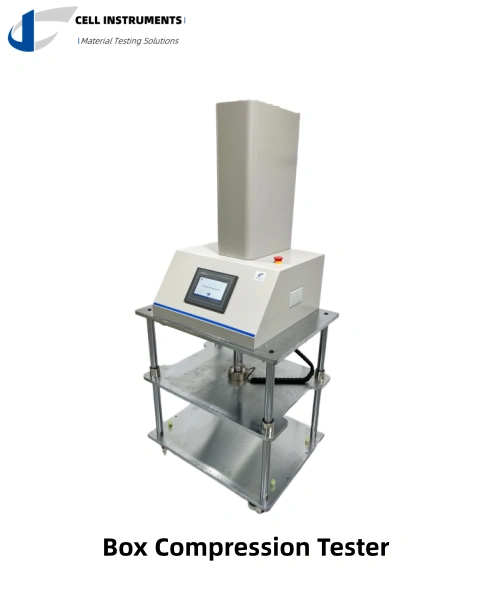
Reliable equipment, such as the Cell Instruments Box Compression Tester BCT-01, supports precise load control, stable platen alignment, and accurate force measurement. These features help laboratories conduct ASTM D642 tests with confidence while improving repeatability.
Sampling and Test Specimen Preparation
Proper sampling ensures meaningful corrugated box compression strength data. ASTM D642 recommends selecting specimens that represent actual production conditions.
Key preparation points include:
- Using complete boxes, with or without contents as required
- Closing and securing boxes exactly as they will be prepared for shipment
- Maintaining consistent flap sealing methods, since flap configuration affects strength
- Testing multiple replicates, often five or more, to improve statistical reliability
Large production runs benefit from lot sampling strategies to capture normal variation.
Applying Compression Testing in Packaging Optimization
Corrugated box compression strength testing supports more than pass-or-fail decisions. Engineers use test data to optimize board grade selection, flute combinations, and box dimensions. Quality teams rely on routine testing to detect process drift before failures occur in the field.
By integrating ASTM D642 testing into packaging development and quality assurance programs, companies reduce risk while improving packaging efficiency.
Final Thoughts on Corrugated Box Compression Strength
Corrugated box compression strength remains a cornerstone metric for transport packaging performance. Through standardized testing aligned with ASTM D642, packaging professionals gain clear insight into stacking resistance and structural reliability.
With appropriate test methods, disciplined sampling, and dependable equipment such as the Cell Instruments Box Compression Tester BCT-01, laboratories can guide informed decisions that protect products, control costs, and strengthen supply chain confidence.
 EN
EN  AR
AR  BG
BG  CS
CS  DA
DA  DE
DE  EL
EL  ES
ES  ET
ET  FI
FI  FR
FR  HU
HU  ID
ID  IT
IT  JA
JA  KO
KO  LT
LT  LV
LV  NB
NB  NL
NL  PL
PL  PT
PT  RO
RO  RU
RU  SK
SK  SL
SL  SV
SV  TR
TR  UK
UK