
Introduction
Fiber drum is widely used for transporting chemicals, powders, and bulk materials due to its lightweight, durability, and cost-effectiveness. Ensuring that fiber drums can withstand stacking and compressive forces during storage and transportation is essential to prevent product damage and maintain safety. The ASTM D642 standard provides a reliable method for performing compression strength tests on fiber drums, boxes, and other shipping containers, offering valuable insights into container performance and durability.
Understanding ASTM D642 and Its Importance
The ASTM D642 test method is a globally recognized box compression test standard that evaluates the ability of shipping containers, including fiber drums, to resist external compressive loads applied to their faces, edges, or corners. This testing is essential for several reasons:
- Safety of Contents: Compressive forces during transport or storage can damage containers and compromise product safety. By measuring compression strength, manufacturers can prevent accidents and product loss.
- Stacking and Storage Reliability: Warehouses often stack containers. Understanding the compression resistance ensures safe stacking without collapsing lower layers.
- Material and Design Evaluation: Testing allows comparison between different fiber drum designs or materials to select the most effective and cost-efficient packaging solution.
- Quality Assurance: Standardized compression testing ensures consistent container performance across production batches.
Test Procedure According to ASTM D642
The ASTM D642 compression strength test involves systematic procedures to ensure reproducibility and accurate assessment:
- Preparation of Test Specimens: Select fiber drums with or without contents. Measure dimensions and document packaging conditions. Proper preparation is crucial to obtain reliable results.
- Placement on Testing Machine: Position the drum centrally on the lower platen of a compression tester. Depending on the orientation being tested, the load may be applied to the top, bottom, edge, or corner. Fixed-platen machines are generally required for edge-to-edge and corner-to-corner tests.
- Load Application: Gradually apply compressive force via relative platen movement until either a predetermined load is reached or the container fails. Ensure the load is applied steadily to avoid peaks exceeding target values.
- Observation and Measurement: After compression, examine the fiber drum for deformation, buckling, or rupture. Measure dimensional changes and inspect contents if applicable. Record the maximum compressive force achieved before failure.
- Orientation Testing: Conduct tests in multiple orientations to evaluate overall container strength, including top-to-bottom, edge-to-edge, and corner-to-corner compression.
Significance and Practical Applications
- Container Design Validation: Fiber drum manufacturers use ASTM D642 data to validate container strength, ensuring they survive stacking, shipping, and handling.
- Material Selection Optimization: Comparing compression performance among different drum materials or construction types helps in selecting the best combination of cost and durability.
- Stacking Simulation: By simulating warehouse stacking conditions, manufacturers can predict performance under sustained loads and prevent package collapse.
- Regulatory Compliance: Many industries require adherence to ASTM D642 or equivalent ISO standards to certify container performance and safety.
Recommended Testing Instrument
For accurate and reliable results, the Cell Instruments BCT-01 Box Compression Tester is ideal for fiber drum testing. Its fixed and swivel platen configurations allow top-to-bottom, edge-to-edge, and corner-to-corner testing. Features include:
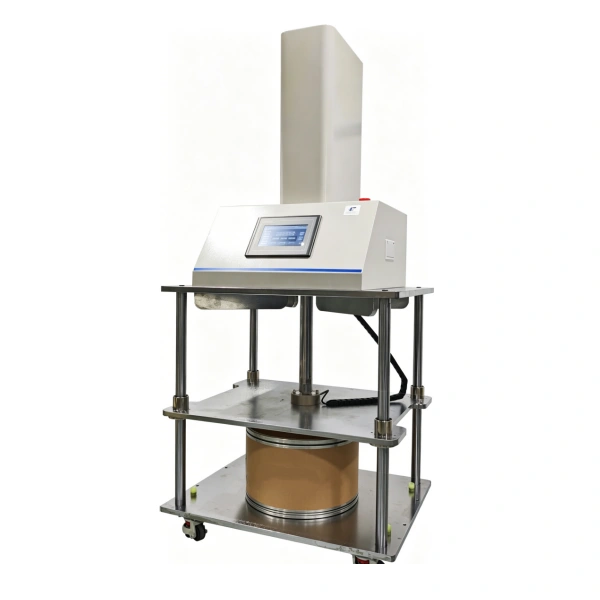
- User-friendly touchscreen interface for test parameter settings.
- Automatic load and displacement recording for consistent data collection.
- Support for unit loads or individual containers, ensuring flexibility in testing scenarios.
Using a high-precision instrument like the BCT-01 improves reproducibility and reliability of compression data, making it easier to make informed decisions about drum design and quality.
Advanced Considerations
Beyond basic compression tests, advanced analysis may include:
- Stacking simulation: Long-duration load application to mimic warehouse stacking.
- Finite Element Analysis (FEA): Predicts weak points and optimizes drum geometry virtually.
- Material testing under different humidity conditions: Assesses performance in varying climates.
Such approaches provide deeper insights into the fiber drum’s performance, guiding better packaging decisions.
Conclusion
The ASTM D642 compression strength test is a vital method for assessing the performance of fiber drums and other shipping containers under compressive loads. By following standardized procedures, manufacturers can evaluate container durability, optimize materials, and ensure safe transport and storage. Implementing reliable testing with instruments like the Cell Instruments BCT-01 ensures reproducible results, strengthens quality assurance, and enhances confidence in container design and performance.
 EN
EN  AR
AR  BG
BG  CS
CS  DA
DA  DE
DE  EL
EL  ES
ES  ET
ET  FI
FI  FR
FR  HU
HU  ID
ID  IT
IT  JA
JA  KO
KO  LT
LT  LV
LV  NB
NB  NL
NL  PL
PL  PT
PT  RO
RO  RU
RU  SK
SK  SL
SL  SV
SV  TR
TR  UK
UK