
Folding boxboard is widely used in the packaging industry due to its versatility, lightweight nature, and protective qualities. Ensuring that these packages can withstand compressive forces during storage, transport, and handling is critical. The packaging compression test provides an objective measurement of compression strength, helping manufacturers evaluate the structural integrity of their packaging and the protection offered to the contents.
Principle and Importance of Packaging Compression Test
The packaging compression test involves applying a controlled compressive force to a filled or empty package to simulate the stresses encountered during stacking or transportation. According to ISO 12048, the test can either focus on full compression until failure or simulate a stacking scenario under a predetermined load and time. This test is essential for:
- Assessing the compression strength of folding boxboard packages.
- Identifying weak points that may lead to deformation, collapse, or product damage.
- Optimizing design for packaging durability and cost efficiency.
- Ensuring regulatory compliance and quality assurance for transport and storage.
By evaluating the compressive performance of packages, manufacturers can minimize product losses, reduce returns, and maintain customer satisfaction.
Detailed Procedure for Packaging Compression Test
- Sample Preparation – Select representative folding boxboard packages, either filled with the intended product or simulated weight loads. Ensure consistency in size, content, and packing method to reduce variability.
- Setting Up the Test – Place the package between the platens of a compression tester. Adjust the instrument according to ISO 12048 specifications, ensuring parallel alignment of the platens to avoid uneven force distribution.
- Applying the Load – For a compression test, gradually apply force until either the package fails or the pre-set load/displacement limit is reached. For stacking simulations, maintain a predetermined load for a specific time or until structural failure occurs.
- Data Recording – Modern compression testers, such as the Cell Instruments BCT-01 Box Compression Tester, record force, displacement, and failure points in real time. These data provide insight into package performance under compressive stress.
- Analysis and Interpretation – Examine the compression strength values and deformation patterns. Compare results to internal standards or industry benchmarks. Key parameters include maximum load-bearing capacity, deformation before failure, and energy absorbed during compression.
Factors Affecting Compression Strength
Several factors influence the results of a packaging compression test:
- Material Quality – Paperboard grammage, fiber orientation, and coating impact strength.
- Package Design – Structural features like flaps, folds, and reinforcements improve load distribution.
- Product Fill – Heavier or unevenly distributed contents alter force distribution.
- Environmental Conditions – Humidity and temperature can weaken boxboard, lowering compression strength.
Maintaining control over these factors ensures reliable, repeatable measurements.
Significance and Industry Applications
The packaging compression test is widely applied in:
- Quality Control – Confirms that folding boxboard packaging meets performance specifications before distribution.
- R&D and Product Development – Guides structural improvements to enhance durability, reduce material use, and optimize cost.
- Supply Chain Management – Evaluates stackability and transportation resilience to prevent damage during warehousing and shipping.
- Regulatory Compliance – Ensures adherence to international standards like ISO 12048 and meets customer and legal requirements.
Proper implementation of compression testing can prevent losses, improve packaging sustainability, and enhance brand reputation by delivering products safely to consumers.
Advantages of Using Cell Instruments BCT-600
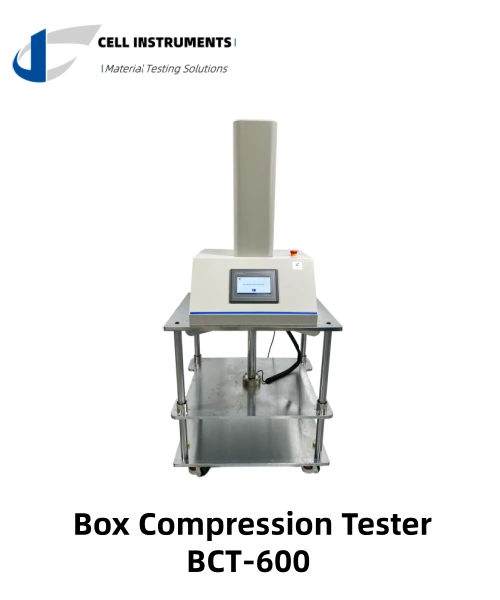
The Cell Instruments BCT-600 Box Compression Tester offers precise, reproducible measurements of compression strength for folding boxboard packaging. Its key benefits include:
- Adjustable test speed and platen alignment for accurate ISO 12048 compliance.
- Real-time data acquisition for load, displacement, and failure points.
- Compatibility with both empty and filled packages, simulating real-world conditions.
- User-friendly interface and automated testing options for consistent results across operators and laboratories.
By integrating the BCT-600 into testing workflows, manufacturers gain reliable insights into package durability, enhancing product protection and overall supply chain efficiency.
Conclusion
The packaging compression test is a vital method for assessing the structural integrity of folding boxboard packages. By measuring compression strength in accordance with ISO 12048, manufacturers can ensure products are adequately protected during storage, transport, and handling. Utilizing advanced instruments like the Cell Instruments BCT-600 enables precise, reproducible testing, helping companies improve packaging design, maintain quality, and satisfy consumer expectations. Implementing compression testing as part of routine quality assurance safeguards both products and brand reputation in the competitive packaging industry.
 EN
EN  AR
AR  BG
BG  CS
CS  DA
DA  DE
DE  EL
EL  ES
ES  ET
ET  FI
FI  FR
FR  HU
HU  ID
ID  IT
IT  JA
JA  KO
KO  LT
LT  LV
LV  NB
NB  NL
NL  PL
PL  PT
PT  RO
RO  RU
RU  SK
SK  SL
SL  SV
SV  TR
TR  UK
UK