
In the world of packaging, the parcel box plays a pivotal role in ensuring the safe transportation and delivery of goods. Whether you are shipping fragile electronics, perishable items, or heavy-duty machinery, the strength of the box is crucial for ensuring that the contents remain intact during the shipping process. The parcel box compression strength test is a key assessment to measure the box’s ability to withstand compressive forces during handling and transit. This article will guide you through the compression strength test, explain its importance, and outline the ASTM D642 standards for conducting this test effectively.
The Importance of Compression Strength Testing for Parcel Boxes
Shipping boxes are subjected to various stresses and pressures during transport, particularly when stacked in large quantities. The parcel box compression strength test simulates these stresses to determine whether the box can hold its contents without collapsing. This test is vital for:
- Ensuring Durability: A box with inadequate compression strength may buckle under pressure, compromising the safety of its contents.
- Improving Packaging Design: By conducting compression strength tests, manufacturers can optimize their packaging designs to improve performance while minimizing material costs.
- Meeting Industry Standards: The test ensures that packaging meets international standards like ASTM D642 and ISO 12048, which help guarantee the reliability of packaging materials used across different industries.
- Customer Satisfaction: Properly tested and durable packaging helps prevent damage during shipping, leading to fewer customer complaints and better brand reputation.
ASTM D642 and Box Compression Test Standard
The ASTM D642 standard outlines the procedures for conducting the compression strength test on shipping containers, including parcel boxes. It specifies how to apply compressive loads to the container’s faces, edges, or corners to determine its ability to withstand external pressure. The test is particularly important for evaluating the box’s performance when stacked during transit.
Overview of the ASTM D642 Test Method
ASTM D642 is designed to simulate the types of compression forces a box will experience during handling, stacking, and storage. The test measures the resistance of the box to compressive forces, which can be applied in different orientations, including edge-to-edge, corner-to-corner, or top-to-bottom.
Test Setup:
- Fixed or Swiveled Platen Machines: The compression strength test can be conducted using either fixed-platen machines, which apply load to the strongest point of the box, or swiveled-platen machines, which apply load to the weakest point of the box. Both methods are valid, depending on the required orientation.
- Types of Tests: The box may be tested in multiple orientations (e.g., top-to-bottom or edge-to-edge) to determine how it performs under different types of compression.
Procedure:
- Specimen Preparation: The parcel box is prepared according to size and material specifications. For example, the box should be tested either with or without contents, depending on the testing requirements.
- Test Execution: The box is placed between the platens of the testing machine. Compressive force is applied gradually until the box reaches its maximum compression strength or fails.
- Data Recording: The maximum force the box can withstand before failure is recorded. This data is used to assess whether the box meets the required compression strength standards.
The ASTM D642 standard also provides a comparison between boxes of different designs and materials, allowing manufacturers to choose the best option for specific applications. Furthermore, this standard ensures that packaging is tested under real-world conditions to predict how it will behave during shipping and handling.
Why Compression Strength Testing is Critical for Parcel Boxes
Compression testing provides valuable insight into how well parcel boxes perform under the pressures they face in transit. Here are some reasons why this test is essential:
- Product Safety: Ensures that the packaging will adequately protect its contents, especially for fragile or perishable items that require secure packaging.
- Compliance with Regulations: Many industries have strict packaging standards, and ASTM D642 helps ensure compliance with these regulations.
- Cost-Efficiency: By knowing the compression strength of a box, manufacturers can use the appropriate material thickness, avoiding unnecessary costs while still maintaining product protection.
- Packaging Optimization: Understanding the limits of box strength helps manufacturers design more efficient packaging, reducing waste and ensuring that the packaging serves its purpose throughout the entire shipping process.
The Cell Instruments Box Compression Tester BCT-600
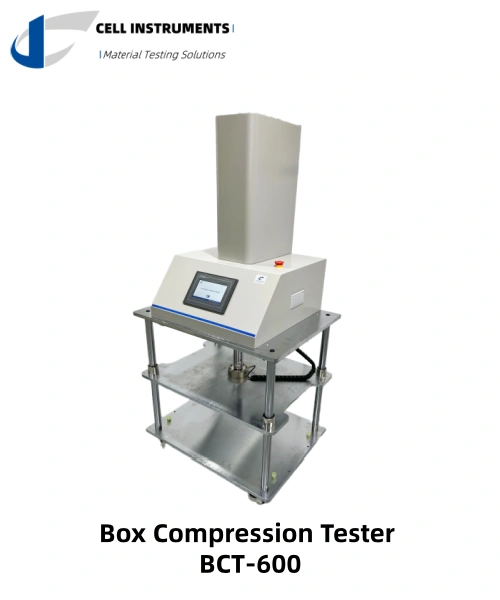
For accurate and efficient compression strength testing, the Cell Instruments Box Compression Tester BCT-600 is a highly recommended tool. This advanced testing machine complies with ASTM D642 and provides precise results for measuring the strength of parcel boxes.
The BCT-600 offers:
- Reliable Results: Provides accurate measurements of compressive force, allowing you to assess the performance of packaging materials and designs.
- Ease of Use: User-friendly interface and simple operation make the BCT-600 suitable for any testing environment, whether in a quality control lab or production facility.
- Versatility: Capable of testing parcel boxes and other shipping containers, making it a versatile tool for packaging manufacturers.
By incorporating the BCT-600 into your quality control process, you can ensure that your parcel boxes meet industry standards for compression strength, reducing the risk of shipping damage and improving the overall quality of your packaging.
Conclusion
The parcel box compression strength test is an indispensable part of the packaging industry. By following ASTM D642 and understanding the box compression test standard, manufacturers can ensure that their boxes are strong enough to withstand the rigors of shipping and handling. Whether you’re in the business of shipping fragile electronics, food, or industrial products, ensuring that your packaging meets the required compression strength is crucial for customer satisfaction and product protection.
For precise and reliable testing, the Cell Instruments Box Compression Tester BCT-600 offers an excellent solution, helping businesses meet ASTM D642 standards and improve their packaging design. With the right testing equipment and adherence to industry standards, you can optimize your packaging for
 EN
EN  AR
AR  BG
BG  CS
CS  DA
DA  DE
DE  EL
EL  ES
ES  ET
ET  FI
FI  FR
FR  HU
HU  ID
ID  IT
IT  JA
JA  KO
KO  LT
LT  LV
LV  NB
NB  NL
NL  PL
PL  PT
PT  RO
RO  RU
RU  SK
SK  SL
SL  SV
SV  TR
TR  UK
UK